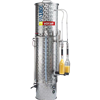
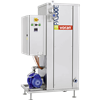
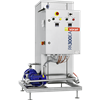
Juice Pasteurizers
Juice pasteurization uses combinations of temperature and time to inactivate disease‑causing microorganisms while retaining as much flavor, color, and nutrients as possible. Commercial processors most often use High‑Temperature Short‑Time (HTST) regimes—typically 71–72°C (160 – 162°F) for 15 seconds or equivalent hotter/shorter combinations—to meet regulatory safety goals.
The pasteurization process can be applied in continuous systems (plate or tubular heat exchangers for HTST) or in batch heating; some processors use ultra‑high temperature (UHT) treatments (much higher temperatures for a few seconds) when shelf stability without refrigeration is required.
Trade‑offs and quality: heat treatment reduces some heat‑sensitive nutrients—vitamin C losses of roughly 15–35% have been reported depending on temperature and time—and can slightly alter aroma compounds, so processors balance safety and sensory quality by choosing the mildest effective time‑temperature combination and using rapid heating/cooling to limit exposure.