Continuous Packing Presses for Cider and Fruit Juice
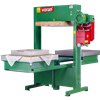
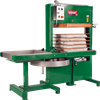
A Packing Press (sometimes called a “rack and cloth” press) has a stationary frame with a carriage that either slides or rotates. At each end of the carriage is a drain basin where the pressing takes place. Milled fruit is spread evenly across the center of a large cloth, then the edges of the cloth are folded over top of it and a thin “rack” (latticed strips of wood, plastic, or stainless-steel) is placed over it. On top of the rack, another cloth is laid and the process is repeated until the stack reaches the desired height. A piston beneath the basin then raises the stack up to a fixed pressing plate and applies increasing pressure, to extract the juice that is layered within the cloths. While the pressing is taking place at one end of the carriage, the rack and cloths are unloaded, cleaned, and reloaded at the other end.
The juice from a Packing Press is typically light and crisp, as there is minimal pulp for it to flow through while being extracted.